Download the Article here.
In Nigeria, secure identity is the key to inclusion. A person’s ability to vote and open a bank account is dependent upon proof of their verifiable personal identity. Since 2007, the National Identity Management Commission Act made it mandatory to use National Identity Numbers (NINs) to access many government services, like the use of Social Security and National Insurance Numbers in the United States and United Kingdom. With a population nearing 220 million and growing, Nigeria is Africa’s most populous country.
Increasing access to technology has helped expand individuals’ access to identity-based services. But criminals, in Nigeria and globally, also leverage technology to commit fraud and steal identities. Ensuring every citizen has a personal verifiable identity that is not vulnerable to fraud is a priority for the Nigerian government and driving force behind the implementation of National Identification Numbers.
Laying the Groundwork: A National Identity Database
Enrolling and authenticating the country’s large population into a National Identification Numbers (NINs) system is a daunting task. Between 2007 and 2015 only 10 million Nigerians obtained a NIN. There were many reasons for this, but reaching citizens in small, remote villages with little or no internet access was a major obstacle.
As direct person-to-person enrollment of 100 million citizens was not feasible, a faster and easier means to engage citizens was needed. Approximately 90 percent of Nigerians have cell phones and use them not only for communicating, but to access internet-based services such as banking.
Both the banking and telecommunication industries already had substantial experience verifying customers’ identities to prevent fraud. In addition to verifying account holders’ identification, they gathered data such as residential address, fingerprints, and facial photos as part of the verification process. Even more significantly, they had started to link customers’ bank verification numbers (BVN) to their Subscriber Identity Module (SIM) cards. With this process already in place, the Nigerian government worked in partnership with the telecommunication companies and provided financial incentives to require anyone purchasing a cell phone to provide personal data
before a receiving an activated (SIM) card.
Fingerprints: The Foundation for Verifiable Collaboration
To ensure the validity of identity information, the Nigerian government wanted to require the telecommunication companies to collect four-finger prints instead of a single print. If implemented, this more stringent requirement would increase security not only for the NINs system but for the banking systems. But first, data siloed in various systems across numerous agencies, and often duplicated, would need to be verified and integrated.
In 2019, the Nigerian government petitioned for and received $433 million from the World Bank and partners to fund citizen registration. The National Identity Management Commission (NIMC), a statutory organization, led the effort, pulling data from the various bank and telecommunication company sources to create a National Identity Database. Each citizen is enrolled and given a unique National Identification Number (NIN) for life, which enables their identity data to be synchronized with data from numerous Nigerian authorities for transactions requiring identity verification. The approach was the right one, and today, Nigerian telecommunication companies are onboarding specifically for the NIMC, linking SIM cards through NINs, which also helps prevent fraud. If a customer’s SIM card is not linked to their NIN, it is deactivated.
The Enrollment Process: A Coordinated Collaboration
To enroll an individual the telecommunications company captures data on each person, including demographics, ten fingerprints, head-to-shoulder photo, and an e-signature. The companies provide that data to the government, who then cross-checks it to ensure there is no duplicate in the National Identity Database and stores it. A NIN with that data attached is assigned to the individual, becoming the sole source for unique identification.
This process requires a coordinated effort between the Nigerian government and supporting technology providers from all over the world, all who have been government-certified as eligible to provide solutions.
Seamfix Powers the NIN Effort
Seamfix, a renowned name in data collection and identity management software, is powering the NIN enrollment project nationwide. The custom made Seamfix Android platform simplifies the NIN enrollment process while ensuring quality and compliance standards.
This platform matches registration data against existing data in the national database to confirm uniqueness before an NIN is issued. As a mobile-enabled platform, it can capture data anywhere, anytime, streamlines onboarding, and requires no physical storage, paper forms, or multiple touchpoints. Identity data is immediately synchronized to a back-end database without the need for human involvement, which keeps the regulatory body compliant with data privacy laws. The approach ensures a clean data output, reducing the risk of erroneous NIN assignment.
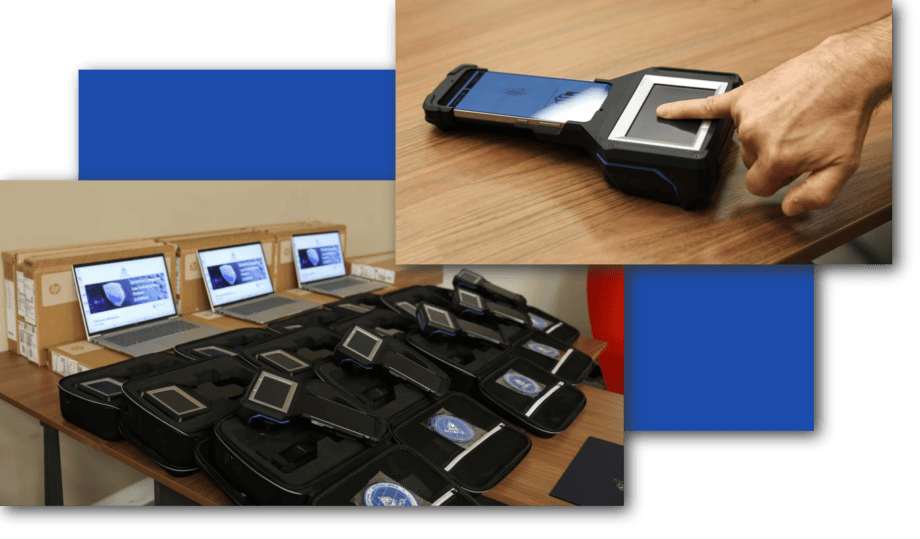
NIMC agents strongly preferred the Kojak scanner. Easy to use and dependable, Kojak overcame the challenges of the Nigerian climate. Agents were able to collect accurate prints, even from dry or dirty fingers, in direct sunlight with an easy-to-read LED graphic user interface. Finally, a full-featured software development kit (SDK) enables effective integration into applications requiring certified FAP 60-quality images. FBI certification and iBeta compliance add additional security and peace of mind.
Kojak is now in use across Nigeria by cellphone companies, including MTN, Glo and Airtel to register and upgrade SIM cards.
Pursuing the Goal of Digital Inclusion for All
As of February 2022, according to NIMC, significant progress has been made. 78 million NINs had been issued, while 125 million out of the 197 million subscribers had submitted their SIMs for linkage to their NINs. The country’s telecom providers and other enrollment agents have opened centers across the country to make it easier for eligible citizens and residents to enroll and link their NINs.
This effort has set the stage for the development and implementation of true eGovernance in Nigeria, but the real story is with its citizens and how NIN inclusion is changing their lives. Identity is a right, not a privilege, and the Nigerian government has improved the delivery of safety net services to everyone, regardless of location or economic status.
Electronic banking, using mobile phones, is now providing financial inclusion, a cornerstone to a better life. Additionally, citizens will have improved access to the critical services everyone deserves. The effort is accelerating growth across the country. With comprehensive national statistics and data, Nigeria is now prepared to address everything from agricultural development, boosting investor confidence, and employment screening to economic planning and distribution of the nation’s resources, all while curbing security issues that could threaten the country’s growth.
Integrated Biometrics Supports NIN Enrollment
Integrated Biometrics (IB) works with NIMC, providing the hardware at enrollment stations. Their scanners needed to overcome 4 major challenges:
- The hardware must have a reliable integration with the Seamfix software
- The biometric finger scanners must work well under dry, dusty and brightly lit conditions without compromising quality
- With more than 80,000 agents in the field to reach citizens in remote parts of the country, the sensors must be portable—small and light, with a long battery life
- The scanners needed to collect prints from four fingers at a time
Integrated Biometrics fingerprint scanners were recommended for their ability to meet these stringent requirements as well as their durability, small size, low power consumption and quality. Over 75,000 of IB’s Kojak FAP 60 10-print scanners supported the enrollment effort.
About Integrated Biometrics
Integrated Biometrics (IB) is a global leader in advanced biometric technology. Renowned for revolutionizing fingerprint scanning through its proprietary, FBI-certified Light Emitting Sensor (LES) technology, the company delivers cutting-edge fingerprint scanners, seamless biometric system integration software, contactless fingerprint capture, and comprehensive identity management beginning with infant identification solutions.
Trusted by organizations worldwide, Integrated Biometrics serves critical sectors such as law enforcement, military, election validation, financial services, and national identity programs. Its robust, high-performance products enable fast and accurate enrollment, identification, and verification, even in remote and extreme environments. IB continues to redefine the possibilities of biometrics—Impacting Lives Through Identity.