Download the Case Study here.
A National Lack of Identification
Until recently nearly all of Ethiopia’s 130 million citizens and legal residents lacked a legal or digital ID. Without one, they could not take advantage of social services, access health insurance, open bank accounts or apply for loans. This left many people unable to fully participate in society and created a loss of economic opportunity both for individuals and the country overall.
With the assistance of the $350 million World Bank-funded “Digital ID for Inclusion and Services” project, Ethiopia plans to provide a digital ID, known as Fayda, to over 90 million people, including refugees by 2030. The Fayda ID, which can be obtained at age 5, will allow people to unlock a wide array of government services and economic opportunities, while greatly reducing the possibility of identity fraud. Fayda is a critical enabler of the national digital government strategy (2025-2030) and is expected to increase the country’s GDP (Gross Domestic Product) and facilitate economic reforms.
Fayda Digital ID: 29.5 Million and Scaling
Before digital identification, Ethiopians relied on paper identification cards issued to verified residents by their local administrative unit (kebeles). With no central registry across more than 16,400 kebeles, and lacking biometrics, the kebele identification system was highly susceptible to fraud and the cards vulnerable to forgery or alteration.
Fayda, ‘value’, is a biometrically verified digital identification, ensuring “one person, one identity”. The Fayda identification number (FIN) is a 12-digit unique identifier for each registrant. Indeed, this proof of identity allows access to digital-based services around the country, including those offered by government and private services integrated into the Fayda system. The National ID Program of Ethiopia (NIPD), in collaboration with the UNHCR and Refugee and Returnee Service (RSS), will provide Fayda IDs to the more than 1 million legal refugees in the country, many of whom lack current identification. To date, over 29.5 million individuals have received their Fayda digital identification number, a dramatic increase from 16.4 million in June 2025. This number is expected to increase to 90 million within a year’s time.
Fayda Registration: Integrated Biometrics Kojak Scanner
To quickly and reliably enroll the population into the Fayda system, the NIDP needed a solution that met MOSIP’s strict standards for biometric data collection and security.
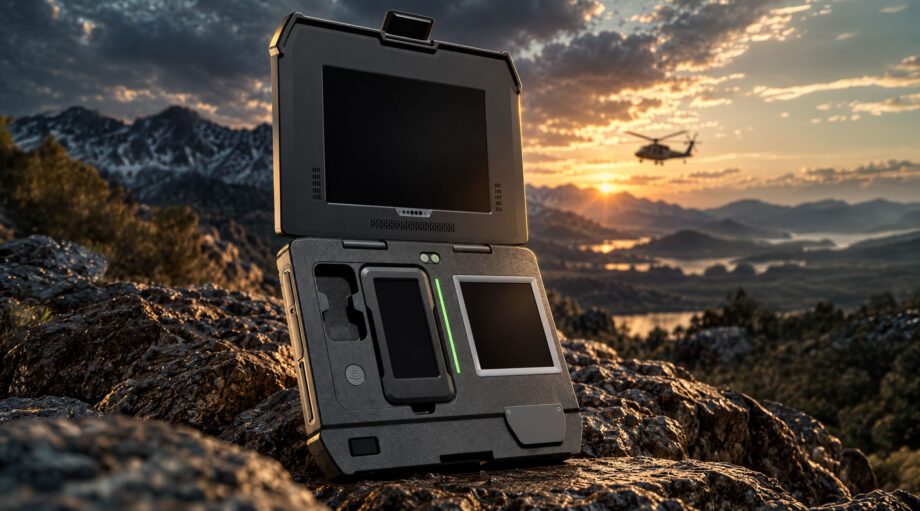
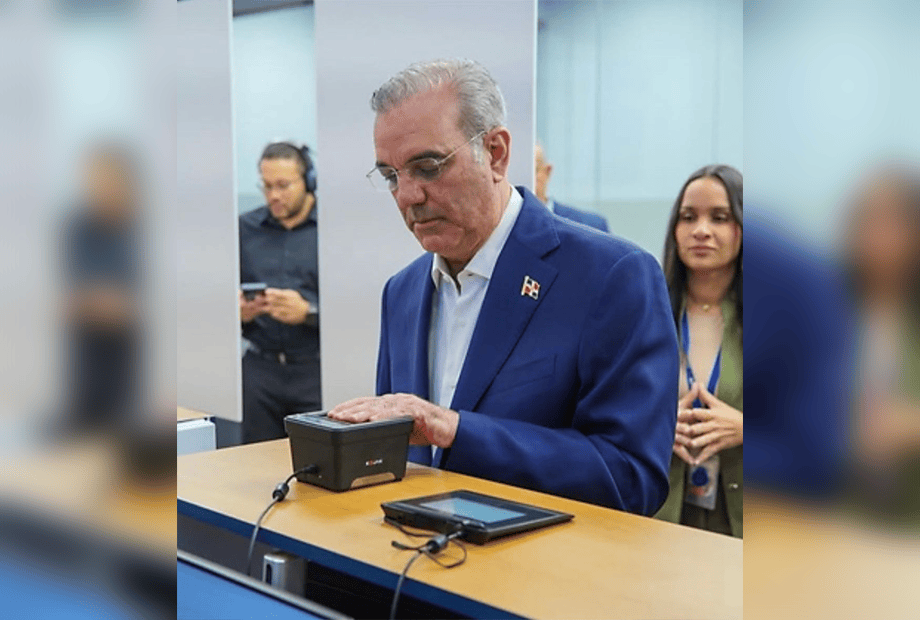
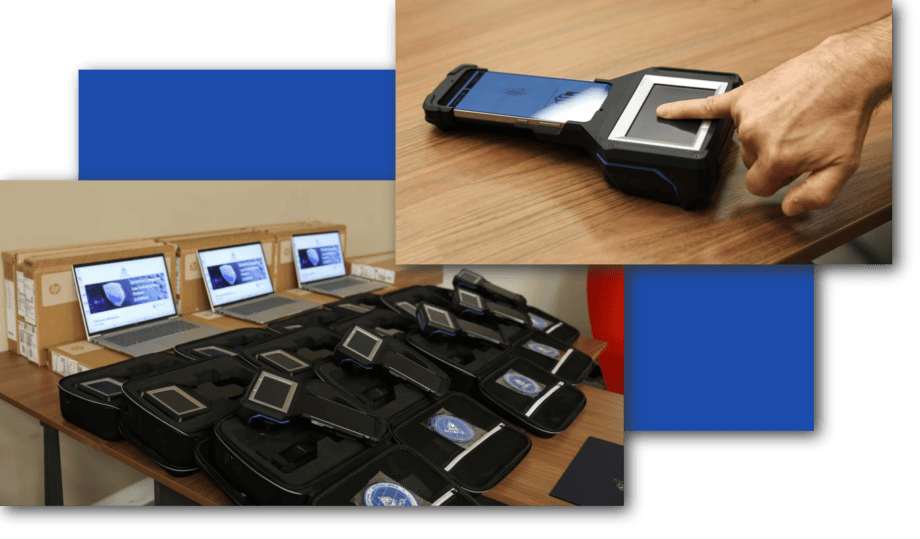
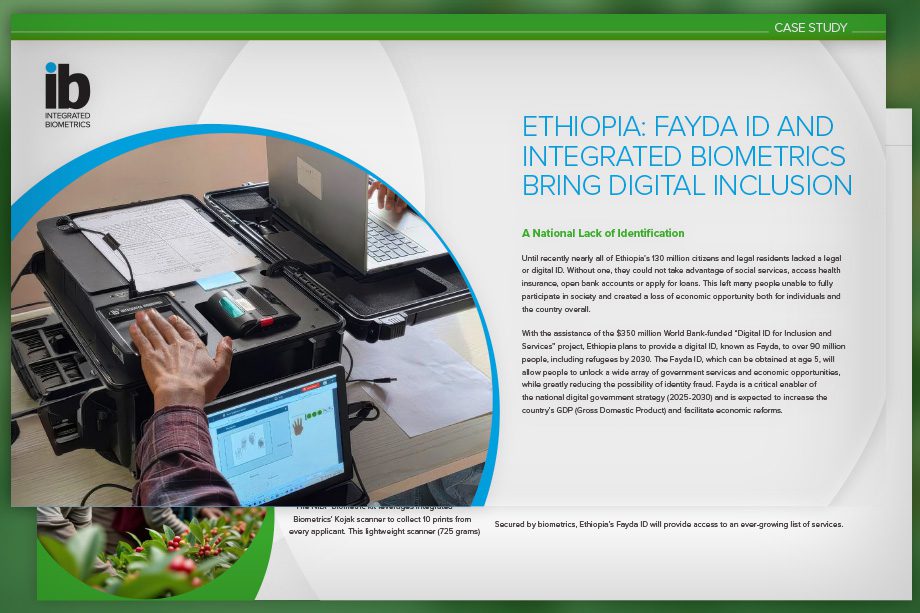
The NIDP biometric kit leverages Integrated Biometrics’ Kojak scanner to collect 10 prints from every applicant. This lightweight scanner (725 grams) rapidly collects prints from dry fingers and can operate in direct sunlight and extreme temperatures. With very low power consumption, the registration kit can operate for lengthy periods of time without an electrical connection. With a goal to register all Ethiopians by 2027, Kojak’s durability, which exceeds US military standards, is critical.
To reach all Ethiopians, the NIDP registration system must operate effectively in remote areas across the country’s diverse and rugged environments ranging from dusty deserts to tropical forests. The kit is lightweight and ultra-mobile, allowing NIDP to enroll participants as close as possible to their homes, increasing the likelihood of successful registration. Neither electricity or an internet connection is required; the unit is powered by battery or solar power.
Digital Inclusion: 91 Agencies and Growing
Even as enrollment continues, the Fayda ID continues to prove its utility for the population and spur Ethiopia’s economic development. Already 91 agencies are integrated into the Fayda system and uses for the Fayda ID continue to expand. Using the Fayda ID has created faster access to services, lower costs and fewer errors.
The Fayda ID gives individuals secure access to services provided by the Ministry of Revenue and Civil Registration and Residency Service Agency (CRRSA). SIM cards are now linked to the Fayda ID, with Ethio Telecom, the country’s largest telecommunications company offering registration at its wide network of service centers. In 2026, the Fayda ID will be a requirement for school registration. Children above the age of five will be issued a biometric digital ID, replacing registration via birth certificate.
The Fayda mobile app allows Ethiopians and residents to easily manage their new national ID. The app offers users secure storage of their ID and the ability to update their changes to their demographic information without having to visit a registration center.
Secured by biometrics, Ethiopia’s Fayda ID will provide access to an ever-growing list of services.
About Integrated Biometrics
Integrated Biometrics (IB) is a global leader in advanced biometric technology. Renowned for revolutionizing fingerprint scanning through its proprietary, FBI-certified Light Emitting Sensor (LES) technology, the company delivers cutting-edge fingerprint scanners, seamless biometric system integration software, contactless fingerprint capture, and comprehensive identity management beginning with infant identification solutions.
Trusted by organizations worldwide, Integrated Biometrics serves critical sectors such as law enforcement, military, election validation, financial services, and national identity programs. Its robust, high-performance products enable fast and accurate enrollment, identification, and verification, even in remote and extreme environments. IB continues to redefine the possibilities of biometrics—Impacting Lives Through Identity.